The International Court of Justice Advisory Opinion on Climate Change
Next steps after the world’s highest court’s groundbreaking ruling
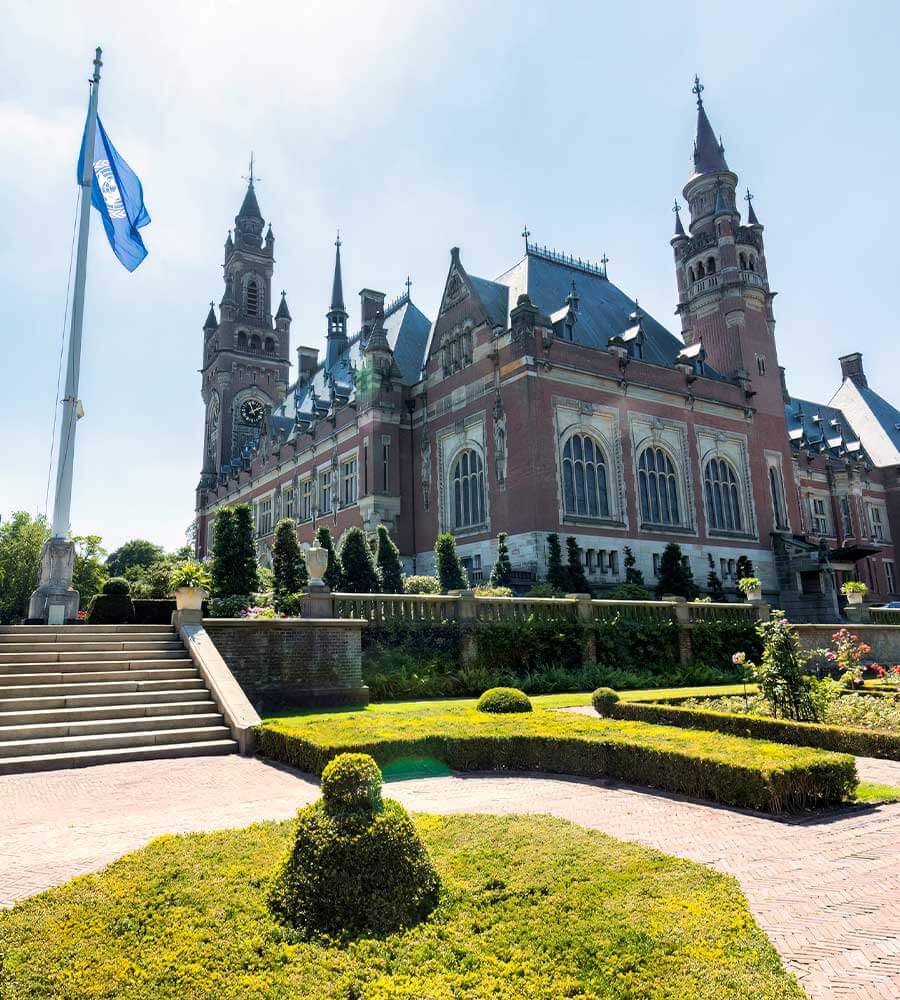
Image: Peace Palace, used by the International Court of Justice (ICJ) of the United Nations in Hague, Netherlands
A turning point for global climate responsibility
After years of grassroots organizing led by Pacific Island students, the International Court of Justice (ICJ) heard the largest climate case in its history on July 23, 2025, with 98 countries and 12 international organizations participating in two weeks of hearings. Now, we’re waiting for an advisory opinion that could help us hold governments accountable for causing the climate crisis.
While the advisory opinions aren’t legally binding, they carry enormous moral and legal weight. This ruling clarified the obligations of countries under international law to protect the Earth and its climate, as well as the consequences if they fail to do so. This ruling provides firm ground on which activists all over the world can build upon.
Check out our YouTube playlist to learn more.
Why the ICJAO matters
This entire journey began in March 2019, with 27 students from the University of the South Pacific who refused to be silent as their islands disappeared. Our partner, Pacific Islands Students Fighting Climate Change (PISFCC), launched a campaign to encourage the UN General Assembly to request this advisory opinion from the ICJ. Six of the world’s 195 countries are responsible for 63% of global carbon emissions. Therefore, we believe in supporting communities and giving those most impacted a platform to raise their voices and concerns.
After years of organizing, on March 29, 2023, the United Nations General Assembly (UNGA) adopted a resolution officially requesting the ICJ to provide an advisory opinion on states’ climate obligations. The ICJAO process created rare opportunities for frontline communities to speak directly to international judges. Throughout December 2024, UUSC supported the Witness Stand campaign, in which thousands of people shared personal testimonies about how climate change has impacted their lives.
From Legal Clarity to Real-World Action
On July 23, 2025, the International Court of Justice delivered a historic, unanimous Advisory Opinion that fundamentally changed the landscape of climate justice. The world’s highest court made it uniquely clear: states have moral obligations to prevent climate harm, protect people and ecosystems, and cooperate in good faith to address the climate crisis.
Having obtained the legal clarity they worked hard to advocate for, our partners at Pacific Islands Students Fighting Climate Change are continuing to urge national governments to operationalize this clarity through collective action.
The Next Crucial Step: The UNGA Resolution
Six months after the ruling was delivered, on February 6, 2026, the government of Vanuatu, alongside a core group of nations, introduced a follow-up resolution at the UNGA to officially endorse and implement the ICJ’s decision. The resolution is offered in the spirit of inclusivity and collaboration. It provides a mechanism that countries can and must implement if we are to work as a world together to address the greatest challenge of our time.
We Cannot Delay Any Longer
Climate impacts are accelerating faster than political responses. The last three years were the hottest on record, and the critical 1.5ºC limit has already been breached. We cannot afford to let action stall.
On Earth Day 2026 (April 22), the world’s nations will vote on this critical resolution. Supporting it strengthens multilateralism at a moment when it is most needed.
Take Action: The U.S. Mission to the UN must either vote in favor of the resolution or refrain from blocking its progress. Click here to send a message to Ambassador Mike Waltz, U.S. Representative to the United Nations, urging him to be on the right side of history.
