
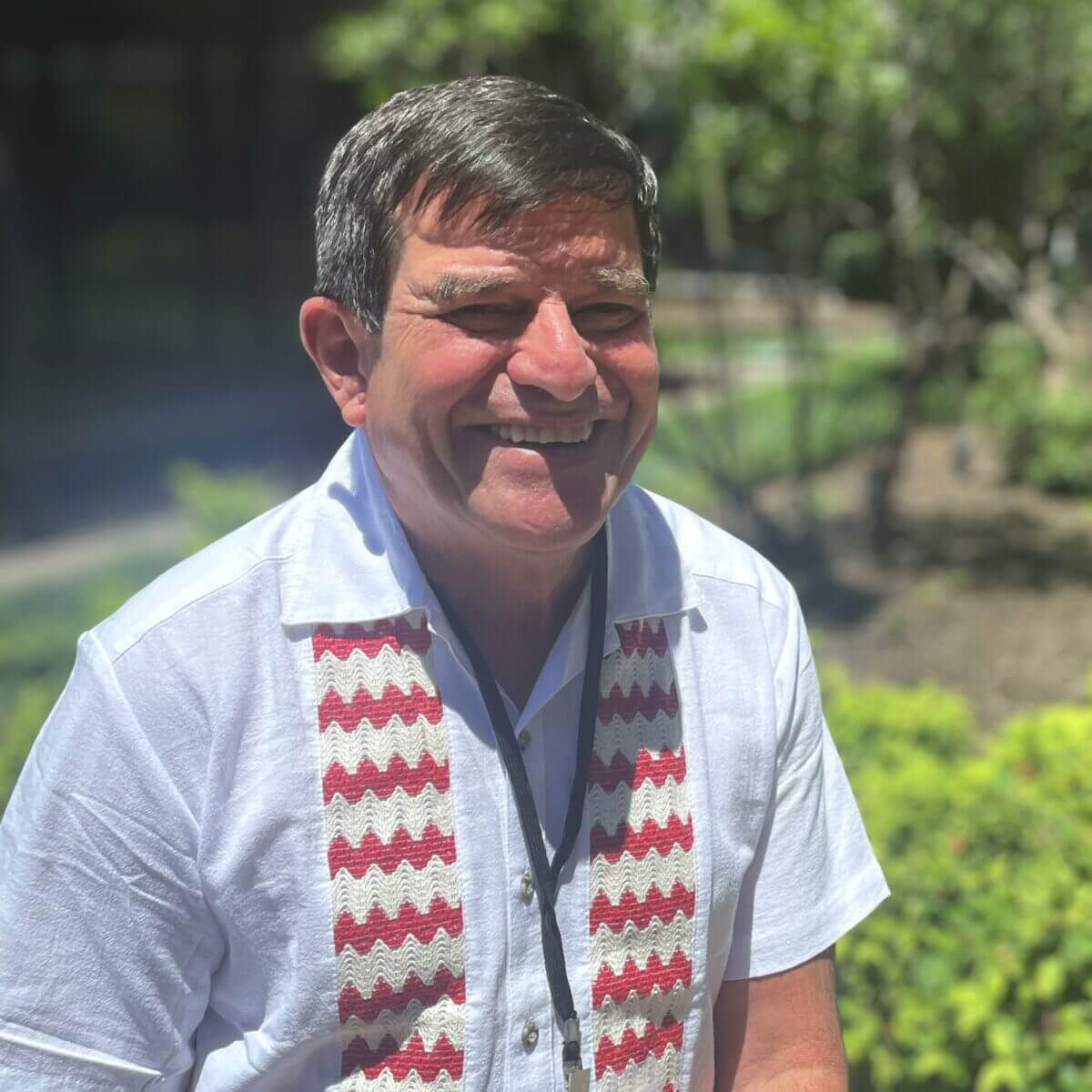
Juan José Hurtado Paz y Paz is a founding member of Asociación Pop No’j and has been its Director since March 2015. A UUSC grantee partner since 2017, Asociación Pop No’j accompanies indigenous Maya communities and organizations in northeastern Guatemala. This article originally appeared in Prensa Comunitaria. It is reposted in full by permission of the publisher and author.
In recent days, voices have been heard defending the U.S. imperialist intervention in Venezuela with the seemingly simple and moralizing argument: there was a dictatorship and it had to be removed. Under this narrative, the external intervention is presented as a necessary, almost humanitarian, action intended to restore democracy and order. History shows us that the opposite is true. Peoples who have suffered colonialism and imperialism have endured devastating long-term consequences in every area.
Furthermore, the risks involved are not adequately acknowledged, as this sets an extremely dangerous precedent: that imperial powers can use force whenever they deem it necessary, disregarding international law and even their own national legislation, as the current president of the United States has done. This approach opens the possibility of repeated external aggression against virtually any country that deviates from the guidelines defined by the empire.
Justifications like the one above not only trivialize the structural violence inherent in imperialist projects but also reflect a profound historical ignorance. Even more serious, they shift responsibility for long processes of dispossession, dependency, and inequality, blaming only current political actors and erasing the colonial legacies and contemporary imperialism that shape present realities.
Colonialism, in its various forms, is not merely a thing of the past but a persistent structure of domination.
From the European invasion of the Americas to contemporary forms of political, economic, cultural, religious, and military intervention, the common thread has been the subordination of peoples to external interests. Far from promoting peace, democracy, or development, colonial and imperialist projects have systematically sought the extraction of resources, geopolitical control, and the imposition of economic and political models that serve the interests of the metropolises.
The discourse of civilization—yesterday in the name of faith and progress, today in the name of democracy and human rights—has served as a pretext to justify invasions, coups, economic blockades, and wars. History demonstrates that these processes do not generate freer or more just societies, but instead fragile states, dependent economies, and deeply fractured societies.
For example, if we want to explain why Guatemala is the way it is, it is essential to go back to the Spanish invasion of 1524. This entailed the systematic dispossession of Indigenous peoples from their territories, their political, economic, and cultural subjugation, and the imposition of a profoundly hierarchical, racist, and classist social order. From this process emerged a structural racism that divided society between Indigenous people and [non-indigenous] Ladinos, denying humanity, rights, and full citizenship to the majority of the population. Likewise, an extractive economic model was established that transformed the country into a producer of raw materials for external benefit, laying the foundations for an economic dependency that, in different forms and involving various actors, has been reproduced to this day.
This experience is not unique to Guatemala. It is a history shared by the peoples of Latin America, as well as by large regions of Africa and Asia, subjected for centuries to colonial and imperialist projects. In all cases, the pattern is repeated: invasion, dispossession, imposition of subordinate local elites, and economies geared toward the plunder of resources for the benefit of the metropolis. Imperialism, regardless of the rhetoric that accompanies it, has not meant autonomous development or well-being for the subjugated peoples, but rather exploitation, dependency, and profound structural inequalities that persist to this day.
More recently, Guatemala offers a paradigmatic example of how imperialist intervention truncated a democratic process and paved the way for decades of violence and suffering. Following the October Revolution of 1944, the country embarked on a cycle of profound reforms aimed at democratizing the state, expanding rights, and overcoming structures that only benefited the landowning oligarchy and large North American corporations. The governments of Juan José Arévalo and Jacobo Árbenz represented a legitimate and sovereign attempt to build a unique development model based on social justice and autonomy.
However, this process was abruptly interrupted in 1954 with the overthrow of Jacobo Árbenz’s government, through an operation orchestrated and executed by the United States Central Intelligence Agency (CIA). The real motive was not the defense of democracy, but rather the protection of economic and geopolitical interests, particularly those of large transnational corporations, in alliance with the most reactionary sectors of the country.
Decades later, the US government itself acknowledged its responsibility for these events, admitting that it had been a cause of the country’s underdevelopment.
The consequences were profound and lasting. The coup not only destroyed an ongoing democratic project but also closed off peaceful avenues for social transformation. Exclusion, inequality, and repression intensified, creating the conditions that led to the 36-year internal war, which left hundreds of thousands of victims, mostly Indigenous people, and produced social wounds that have yet to heal.
To claim that Guatemala’s internal war was solely the result of decisions made by local actors is a form of historical denial. Without the 1954 intervention, it is reasonable to think that democratic reforms would have continued, reducing social tensions and making an armed confrontation of such magnitude unnecessary. The war was the result of a process of closing off political spaces for the country’s transformation, imposed with the overthrow of Árbenz.
This historical lesson is fundamental to understanding the present. Every time imperialist intervention is legitimized under moralizing arguments, the same pattern is repeated: the sovereignty of peoples is ignored, internal processes—with all their contradictions—are dismantled, and external solutions are imposed that, far from solving the problems, exacerbate them.
The aggression against Venezuela is part of this long tradition. Beyond the legitimate criticisms that can be made of its government, none of them justify foreign intervention, economic sanctions, or military threats. These actions primarily punish the people, deepen social crises, and reinforce authoritarian dynamics, rather than weakening them.
Those who applaud these measures seem to forget—or be unaware—that imperialism doesn’t come to emancipate, but to control. Latin American history is replete with examples that confirm this reality. To believe that this time will be different is not only naive, but dangerous.
Defending international law and the self-determination of peoples does not mean idealizing governments or denying their mistakes. Rather, it means recognizing that real and sustainable change can only arise from the people themselves, through internal, democratic, and sovereign processes. Historical memory, especially in countries like Guatemala, should serve as a warning against the siren song of interventionism.
The United States has acknowledged, albeit belatedly, its responsibility for the destruction of Guatemalan democracy. This acknowledgment does not bring back the lost lives nor fully repair the damage done, but it offers a clear lesson: imperialist intervention does not bring development or peace. It brings dependency, violence, and suffering.
Justifying current imperialist aggression with arguments focused solely on the immediate is to ignore centuries of history and the painful experiences of our peoples.
Guatemala demonstrates that when democratic avenues are closed from the outside, the consequences are tragic and far-reaching. Today, more than ever, it is necessary to reclaim historical memory, denounce colonialism and imperialism in all its forms, and defend the right of peoples to decide their own destiny, free from external tutelage and imposition.


