“The role of the artist is to make the revolution irresistible.” -Toni Cade Bambara

I doodled this quote in Lisbon, Portugal while listening to global leaders discuss narrative strategy in the gender justice movement. As UUSC’s Content Creator, I had the distinct privilege of documenting our urgent new event: Converging Futures, 2026.
Leaders from grassroots movements, progressive faith communities, legislative advocacy, and research came together for the 3-day convening. They aimed to establish shared strategies to advance gender justice.
Across the globe, conservative institutions galvanize religious communities to further transphobic, homophobic, and misogynistic agendas. What if leaders from the justice movement and progressive faith communities coordinated more closely to promote trans-affirming, feminist policies and thought?

At Converging Futures, participants leaned into the mobilizing potential of progressive faith spaces, while interrogating religion’s complex relationship to social power. They held panel discussions on the anti-gender movement’s successful strategies and faith-based resistance efforts. Participants broke off into discussion groups organized by focus area and geography. They identified strategic building blocks and future priorities.
The global leaders of Converging Futures will have many more reflections on the work that emerged from the event. As the creative documentarian in attendance, I left Lisbon deeply impacted by the transformative power of collaborative imagination.

At UUSC and in broader movement work, we spend a lot of time talking about imagining a new and better future. When the convening started, many participants shared how tiring it is to continually talk about tomorrow when folks are struggling to survive right now. What’s a liberated future to someone presently incarcerated for migrating? What good is a better tomorrow to someone denied life-saving gender affirming healthcare today?
The justice movement will always navigate the tension of managing both immediate crisis response and long-term, sustainable change. In an era of acute state violence, it is natural to be overwhelmed by the present. Collaborative imagination and creative practices, however, allowed participants to overcome the inundation of crises. They could be present with one another in the convening space. They could build relationships and make strides toward shared strategy, even while carrying trauma and exhaustion.
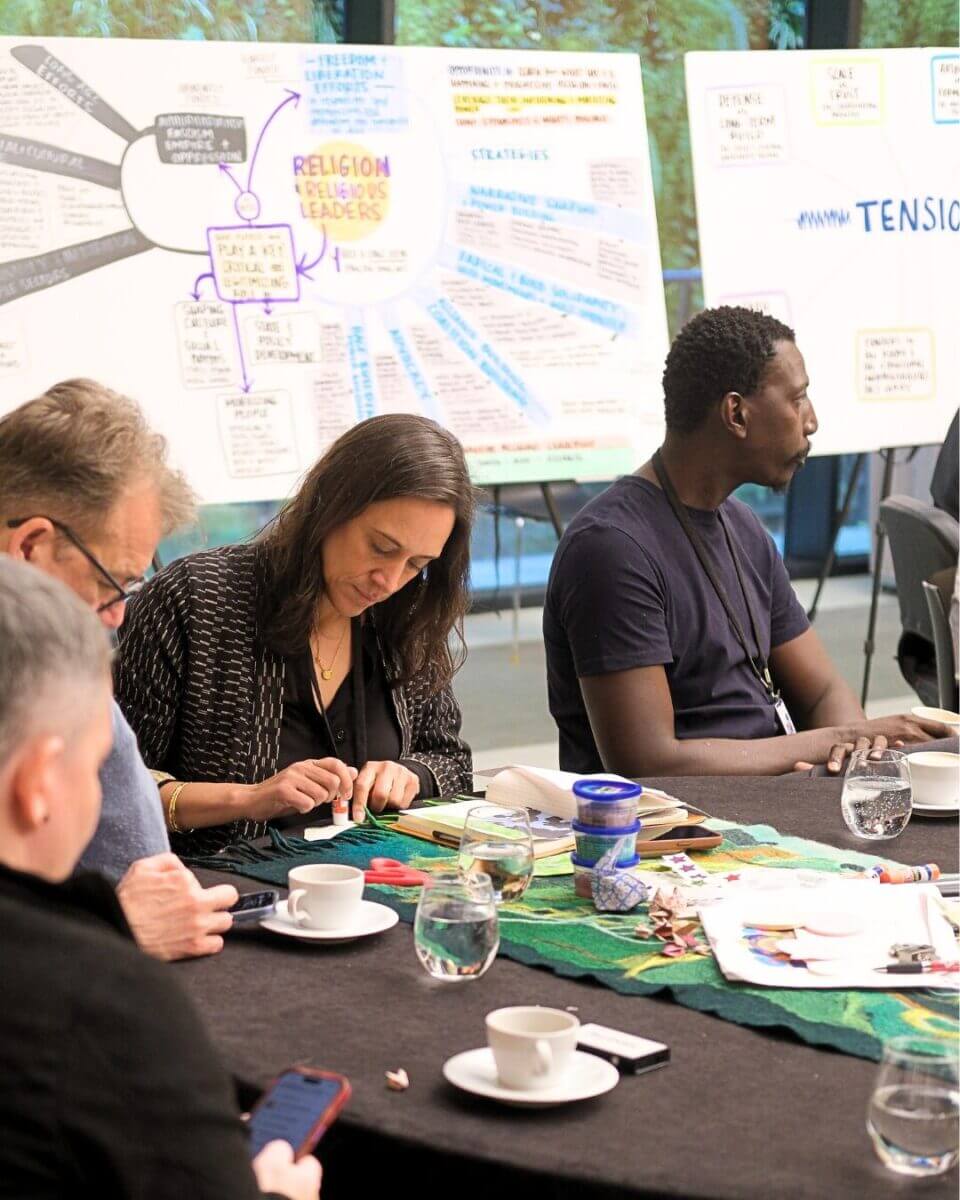
Convening facilitator Angelika Arutyunova cultivated this creativity by inviting participants to connect with one another through art. Each day started with somatic movement practices and often poetry. Claudia Lopez, a graphic illustrator, captured participant reflections in real time through huge drawings that mapped collaborative thought.
In the meeting space, every table was adorned with a fantastic mess of art supplies. While sharing wisdom and building strategy, participants tore into decorative paper and passed around glue sticks. They collaged. They built towers out of putty. When UUSC staff reorganized the room at the end of each day, we found piles and piles of origami birds.
Hope for the future can be a powerful tool in resistance efforts, but the incredible thing about human imagination is that it transcends time. Creativity doesn’t require that we look forward to innovate; it is just as easily activated by the past.

Throughout the convening, participants invoked the power of memory. They recalled both the recent past and the long history of social resistance and progressive faith. Some participants had five decades of experience in movement work, while others had fewer years but fresher eyes. Participants used collaborative imagination to connect the strategies of the past with the tools of today. Their shared creativity resulted in clear tactics to strengthen and advance the gender justice movement.
The antidote to authoritarianism is not simply imagination. The agendas of transphobia and misogyny are also imaginative, in horrifying ways. If the political right uses their creativity to build violent structures and narratives, we must use ours to develop better approaches to defend and advance gender justice.
As a queer artist working for a human rights organization, I was struck by the power of creative practice at Converging Futures. Collaborative creativity unlocked memories and built relationships. It connected the work of the past to the strategies of today.

The convening reminded me that a feminist future is embodied, imaginative, and collaborative. Creative practices and storytelling are not layered on top of movement strategy; they are core parts of the strategy itself. I have never felt more honored to serve as an artist in movement work, and I’ve never been clearer that my calling is to make the revolution irresistible.